For decades, silicon chips have followed the rigid architecture established by John von Neumann in 1945: keep the central processing unit (CPU) physically separate from memory storage. Every time your computer performs a calculation, data travels back and forth along microscopic metallic pathways between memory and processor.
As artificial intelligence workloads explode, this back-and-forth movement has created the von Neumann bottleneck—a physical wall where data transfer consumes huge amounts of power and generates massive heat. To solve this, computer engineers are turning to biomimicry with neuromorphic computing.
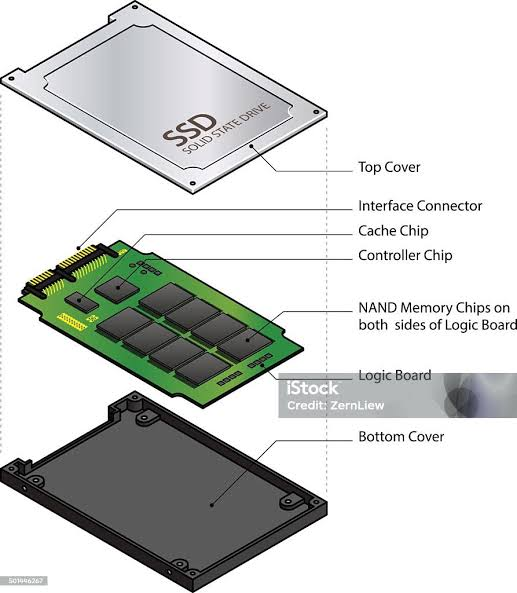
Standard hardware architectures separate memory and processing into distinct physical components. Source: iStock
What Is Neuromorphic Hardware?
Neuromorphic computing redesigns silicon microchips to mimic the physical structure and operational mechanisms of the human biological nervous system.
Instead of traditional logic gates processing binary ones and zeros on a fixed clock cycle, neuromorphic chips use artificial neurons and synapses integrated onto the exact same physical substrate:
-
Spiking Neural Networks (SNNs): Unlike traditional software neural networks that process every piece of input constantly, neuromorphic chips use event-driven communication. Neurons only fire (or “spike”) when electrical signals cross a specific threshold.
-
Co-Located Memory and Processing: By storing data directly inside artificial synapses, neuromorphic chips eliminate the continuous transfer of data across external memory buses.
-
Asynchronous Execution: Chips run without a master system clock, processing information only when incoming data changes.
The Efficiency Shift: Brain vs. Supercomputer
The human brain consumes roughly 20 watts of power—about as much as a single LED light bulb—to perform complex pattern recognition, natural language processing, and spatial navigation simultaneously. In contrast, training a modern frontier AI model on conventional GPU clusters consumes megawatts of electricity.
| Feature | Von Neumann Architecture | Neuromorphic Architecture |
| Data Flow | Sequential (Bus transfer between CPU & RAM) | Parallel (In-memory compute) |
| Clock Logic | Synchronous (Ticked by system clock) | Asynchronous (Event-driven spikes) |
| Power Draw | High (Continuous energy consumption) | Ultra-low (Zero energy drawn when idle) |
| Primary Strength | Precise arithmetic, database management | Real-time sensor processing, edge AI |
Real-World Edge Applications
Neuromorphic silicon is not meant to replace high-speed database servers. Instead, its event-driven efficiency unlocks instant processing for resource-constrained edge devices:
-
Autonomous Drone Navigation: Processing optical flow signals from vision sensors in real time with milliwatt power budgets.
-
Wearable Health Monitors: Tracking complex ECG anomalies directly on a smartwatch without draining the battery.
-
Robotic Touch & Sensing: Processing thousands of tactile pressure sensors across a robotic limb instantly without latency lags.
The Road Ahead
Neuromorphic computing represents a fundamental shift in hardware philosophy. By shifting from brute-force binary calculation to biological event processing, chipmakers are paving the way for autonomous devices that think, sense, and adapt efficiently directly at the edge.